Customer experience
- Onboarding
- Discovery
- Transaction
Product engineering packet · ACL / 001
App Clone Labs helps founders and product teams define, design, engineer, validate, and hand over connected digital products—not disconnected screens.
02 / BUILD ROUTE
The responsible route becomes clear when product differentiation, operational complexity, technical constraints, and reuse are evaluated together.
Start with an existing foundation when its core roles, transaction model, and operational flow genuinely fit the intended product.
Design from the business specification when the rules, integrations, compliance context, or experience require a purpose-built architecture.
Introduce retrieval, agents, recommendations, or automation only where defined data, controls, and human review make them useful.
03 / REFERENCE PROTOCOL
A recognizable product can create a shared vocabulary. It is a starting point for analysis, never permission to copy protected expression or skip product definition.
Review custom clone developmentUse a known product only to clarify expected actors, mechanics, states, and category conventions.
Exclude protected source code, brand assets, content, and assumptions that do not belong in the new product.
Define original users, permissions, business rules, data, integrations, exceptions, and release boundary.
Create a distinct interface and connected customer, provider, operator, and administrative experience.
Implement the agreed applications, services, infrastructure, controls, tests, and documentation.
Review the system against acceptance criteria, deployment readiness, and the applicable agreement.
04 / SERVICE REGISTER
Engage App Clone Labs for a connected product or a clearly bounded workstream. Each route below maps to an existing service path.
05 / SOLUTION DISCOVERY
These paths use familiar category references to explain workflows. Brand names identify reference categories only; no affiliation or endorsement is implied.
Rider, driver, dispatch, location, fare, payment, and safety workflows.
Guest, host, listing, availability, booking, payment, review, and support workflows.
Catalog, substitution, shopper, fulfillment, order status, and operator workflows.
Profiles, catalog, discovery, playback, subscription, moderation, and content operations.
Creation, feed, engagement, moderation, reporting, and creator operations.
Identity, conversations, delivery states, notifications, privacy, and administration.
06 / OPERATING SYSTEM PLATES
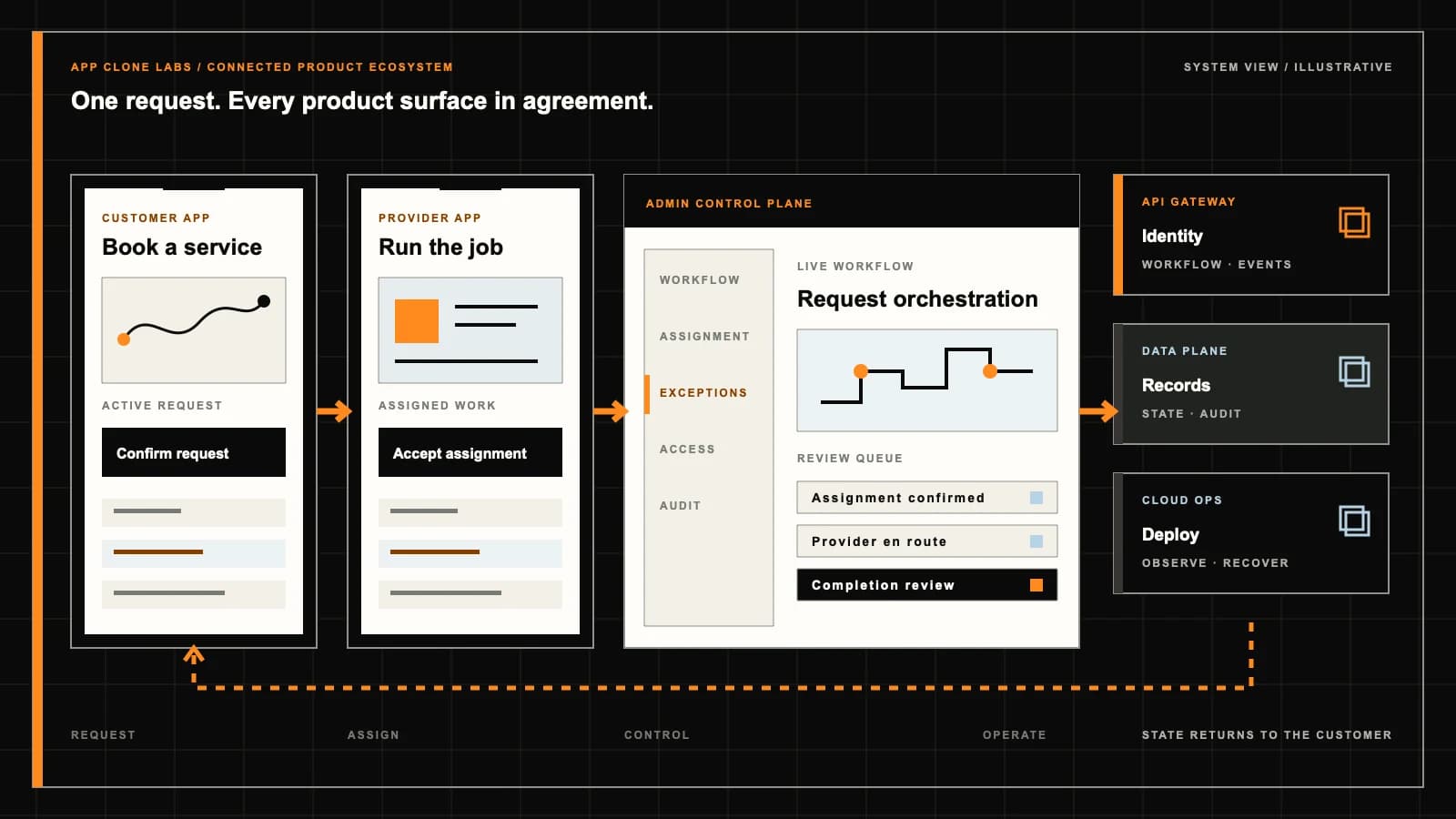
These are explanatory system models, not client case studies. They expose the actors, transaction spine, and operator controls a real scope must resolve.
A listing is not a marketplace. Supply, demand, money, trust, and intervention must resolve through one state model.
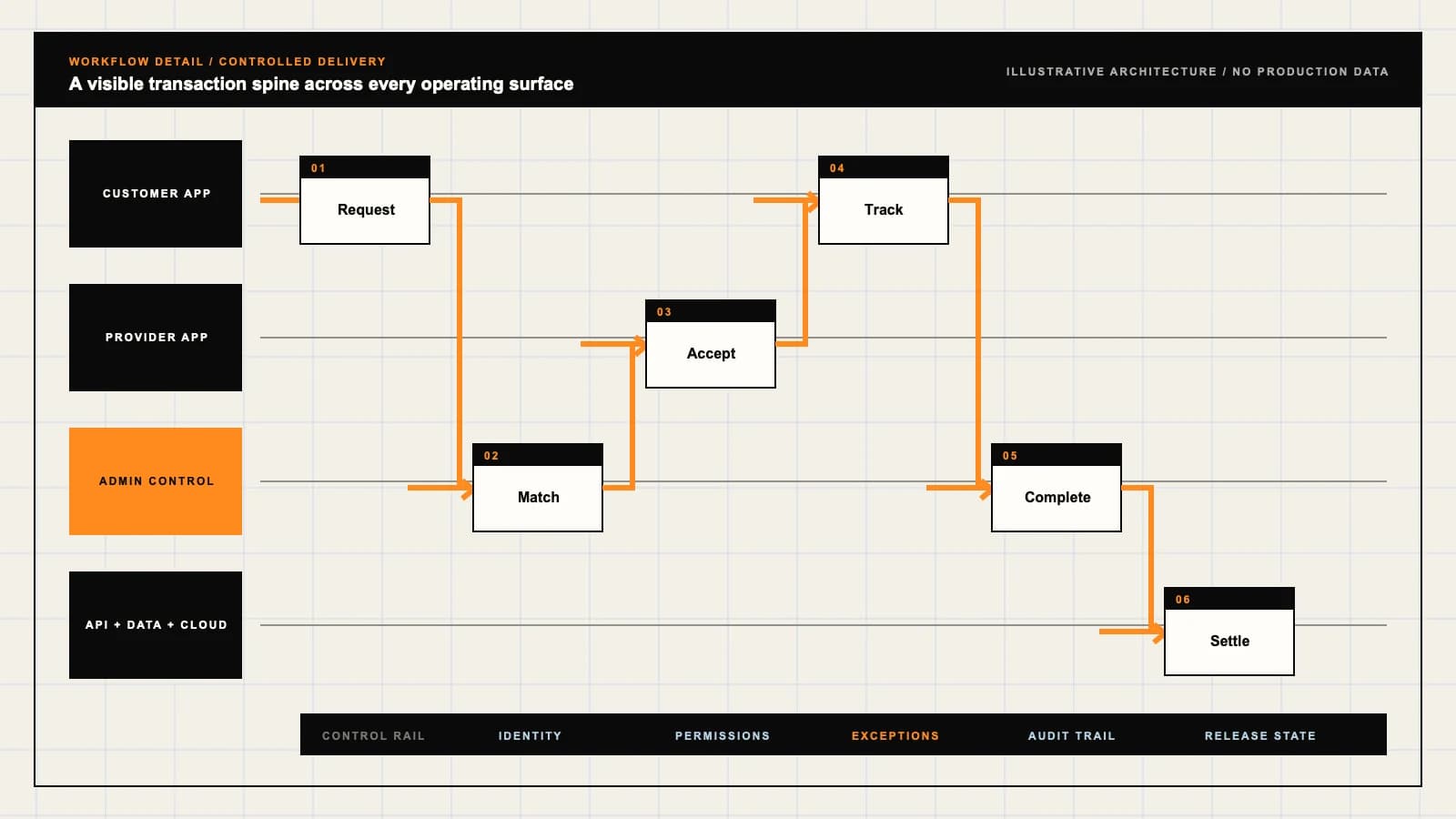
A request must become assignable work, remain visible through exceptions, and close with an accountable payment state.
The workspace, account hierarchy, entitlements, billing, support, and platform administration have to agree.
07 / ENGAGEMENT OUTPUT
Exact deliverables vary by scope and agreement. A credible engagement identifies reviewable outputs rather than hiding progress behind activity.
Actors, jobs, journeys, business rules, assumptions, exclusions, and a prioritized release boundary.
Information architecture, key flows, interface direction, component logic, states, and reviewable prototypes as scoped.
System context, service boundaries, data concepts, integration map, environments, and non-functional considerations.
Milestones, dependencies, decisions, risks, acceptance criteria, and an agreed review cadence.
Test scope, issue status, deployment checklist, known limitations, and launch-readiness review.
The contractually agreed code, design assets, documentation, credentials, access transfer, and support route.
08 / CONTROLLED DELIVERY
Sequence and depth are adjusted to the engagement. The operating principle remains: resolve risk early, build in reviewable increments, and define release and transfer.
Review the full processAlign the commercial objective with the people, workflow, constraints, and first complete business loop.
Design the connected experience and technical shape before expensive dependencies become hidden.
Engineer prioritized slices across interfaces, services, integrations, and operational controls.
Test against the agreed scope and prepare environments, access, monitoring, and release actions.
Complete the agreed production, store, documentation, credential, training, and support activities.
09 / PRODUCTION READINESS
Requirements differ by product and jurisdiction. These workstreams are surfaced during scoping and implemented to the extent stated in the engagement.
Named decision owners, review points, scope control, risk tracking, and acceptance responsibilities are established for the engagement.
Resolved against scopeIdentity, access, data handling, secrets, dependencies, logging, and environment boundaries are considered against product context.
Resolved against scopeSemantic structure, keyboard use, readable states, contrast, labels, and relevant platform guidance are included in design and QA planning.
Resolved against scopeAcceptance criteria, test coverage, regression needs, device or browser scope, defects, and release gates are made visible.
Resolved against scopeEnvironment separation, deployment, monitoring, backups, recovery, scaling assumptions, and operational ownership are resolved as scoped.
Resolved against scopeCode, reusable elements, third-party terms, documents, accounts, credentials, training, and support are itemized in the agreement.
Resolved against scope10 / ENGAGEMENT MODELS
Commercial structure, roles, governance, and deliverables are confirmed in the applicable proposal and agreement.
11 / OPERATOR MODELS
Trust, data, fulfillment, regulation, monetization, and exception handling vary by context. The architecture must follow those realities.
Explore all industriesIdentity, permissions, transaction states, auditability, and regulated-context planning.
Sensitive workflows, role boundaries, data handling, care operations, and accessibility.
Orders, dispatch, tracking, exceptions, proof of action, and operator visibility.
Learner, educator, content, assessment, progress, and administration models.
Inventory, discovery, inquiry, agent workflows, documents, and lifecycle operations.
12 / LEADERSHIP
App Clone Labs presents product strategy, growth systems, and delivery thinking through role-based leadership profiles and authored guidance.
Founder and Product Strategy Lead
DG / 02Growth Systems and Delivery Lead
Strategy, design, engineering, QA, cloud, and operational thinking are assembled around the agreed engagement.
Meet the team12B / KNOWLEDGE HUB
Blog notes, case records, comparison guides, and education planning resources are indexed for founders, operators, and engineering leaders.
13 / FOUNDER REFERENCE DESK
Planning resources help teams ask better questions before scope, architecture, commercial assumptions, or delivery commitments are fixed.
14 / PROOF METHODOLOGY
We do not use invented client stories, testimonials, or unsupported performance figures as substitutes for diligence. Where public proof is limited, buyers should test the delivery method directly.
Ask whether users, rules, exclusions, dependencies, assumptions, and acceptance are explicit.
Inspect how customer experience, operations, data, services, security, and deployment connect.
Use prototypes, architecture records, working increments, test evidence, and decision logs as review points.
Confirm deliverables, responsibilities, third-party terms, ownership and licensing, access, support, and handover.
15 / BUYER QUESTIONS
The useful answer is the one that remains true in the proposal, agreement, implementation, and handover.
Open the full FAQNo. A reference product can help explain category mechanics and user expectations. The delivered product requires original branding, interface design, workflows, implementation, content, and business rules. Third-party proprietary source code and protected brand assets are not part of the service.
The decision depends on fit across roles, workflow, data, integrations, compliance context, scale assumptions, and intended differentiation. The proposal should identify what is configured, newly engineered, reused, licensed, or excluded.
The appropriate discovery depth depends on the engagement. It can establish actors, workflows, rules, scope, risks, dependencies, architecture direction, acceptance expectations, and the delivery plan before implementation.
Yes. An engagement can be structured around discovery, a defined build, a specialist workstream, or an embedded team, subject to the organization’s procurement, security, legal, technical, and governance requirements.
They are scoped against the product, data, jurisdictions, vendors, and client requirements. App Clone Labs can plan and implement agreed controls, but legal or regulatory compliance requires appropriate client and specialist review and is not implied by general development work.
The applicable agreement defines handover. It may include the agreed source-code package, design files, documentation, deployment access, administrative credentials, and operating guidance. Reusable frameworks and third-party components remain subject to their stated terms.
Ownership and licensing are governed by the signed agreement. It should distinguish client-specific deliverables from reusable know-how, pre-existing materials, open-source software, third-party services, and licensed components.
Timing depends on scope, selected foundation, integrations, platform coverage, content and data readiness, review speed, testing needs, and third-party or store approvals. Milestones and assumptions should be established after discovery rather than promised unconditionally.
No product team can responsibly guarantee market adoption, revenue, funding, regulatory outcomes, app-store approval, or third-party decisions. The engagement can define product, engineering, quality, and launch-readiness responsibilities.
16 / STARTING INPUT
Tell us who the product serves, what must happen end to end, where the operational risk sits, and what has already been decided. We will use the initial conversation to identify the questions and delivery route to examine next.